Fundamental learning principles: the first round of source searching
Five fundamental principles from learning science, gathered in the first round of source searching, before they are connected to interaction design.
- literature review
- learning
- process
In this project I want to look at learning in the context of interaction design, and the first step in that process has been to get to know the basic theory of how we humans learn. With limited time in this first round of mapping the literature, I have chosen to narrow things down sharply, to five principles that lay the foundation for modern learning science.
Here is what I have found so far.
1. The spacing effect (spaced repetition)
Carpenter et al. (2012) Ebbinghaus (1885)This is one of the oldest principles within human learning. Spreading the learning out over time helps us store the information.
One of the first to talk about this was Ebbinghaus, who in 1885 described "the forgetting curve": how we gradually forget things over time, and how repetition can counteract this effect.
Carpenter, Cepeda, Rohrer, Kang & Pashler explored how these principles can be put to use in the best possible way. They tested their way to what the optimal gap between study sessions was.
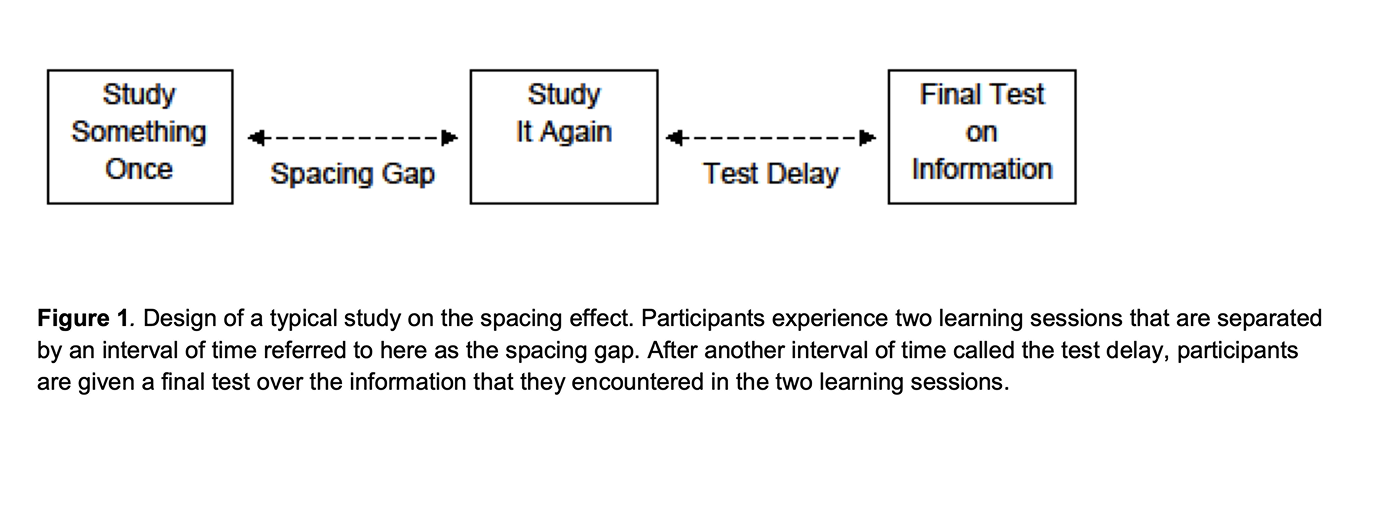 Figure 1: Design of a typical study on the spacing effect. The participants go through two learning sessions
separated by a time interval called the spacing gap. After another time interval called the test delay, the
participants are given a final test on the information from the two learning sessions. From Carpenter et al.
(2012).
This model, the spacing gap and the test delay as two independent variables, is useful to keep in mind. It is not only spreading the study sessions out that affects the learning outcome, but an interplay between how long you wait between the study sessions and how long it is until the material is to be tested that decides what is optimal.
2. Retrieval practice (the testing effect)
Roediger & Karpicke (2006)Roediger & Karpicke researched the value of testing for learning. The core finding is counterintuitive: to retrieve information from memory (that is, to test yourself) strengthens learning more than reading the material again, especially if the goal is to hold on to the knowledge over time.
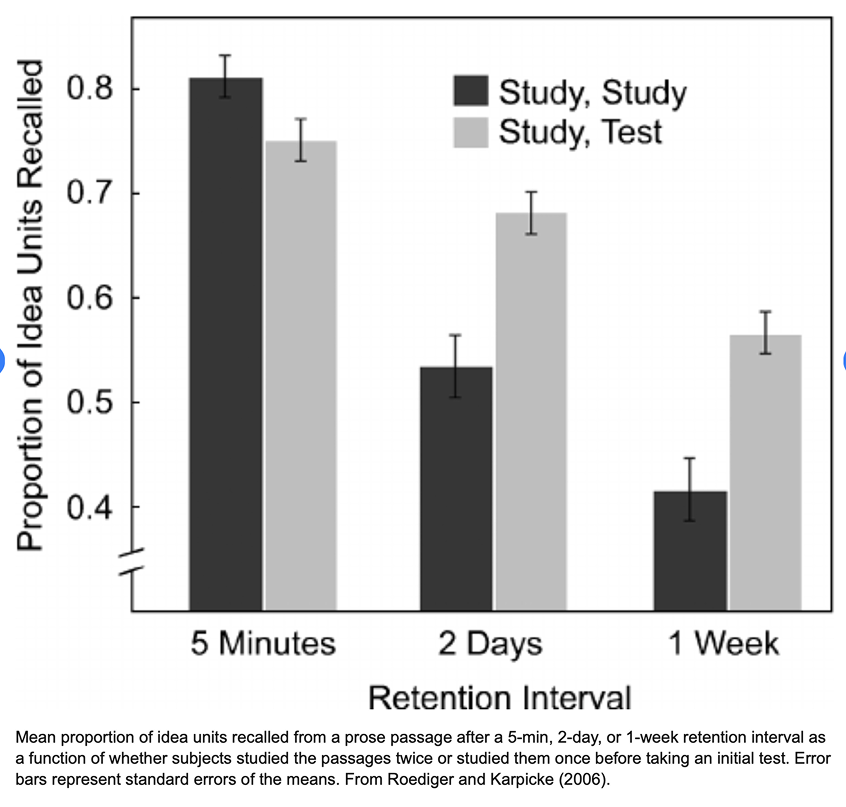 Mean proportion of idea units recalled from a prose passage after a 5-min, 2-day, or 1-week retention
interval, as a function of whether the participants studied the text twice or studied it once before taking
an initial test. From Roediger and Karpicke (2006).
When the material is to be recalled after 5 minutes the "Study, Study" group clearly wins, but already after two days the "Study, Test" group has caught up and passed it, and the lead grows at one week. Another interesting finding was that the students who only crammed by rereading had the highest confidence in their own mastery, but actually performed worst over time.
3. Cognitive load theory
Sweller (1994)The core idea here is how you design information so as not to overload working memory.
Learning is about building "schemas": mental packages of knowledge that we can eventually use automatically without consciously thinking through every element. Before we have built these "schemas" for new information, it puts a large cognitive load on the brain. The difficulty (and with it the load) of something we are going to learn depends on element interactivity: how many parts of the material have to be understood at the same time because they are connected.
The load on working memory limits how many new concepts the brain can hold at once.
Sweller distinguishes between two types of cognitive load:
- Intrinsic load: lies in the nature of the material itself and cannot be removed with better teaching
- Extraneous load (unnecessary or artificial): created by poor instructional design, and can be reduced
Good instructional design can therefore reduce the load on working memory, and make way for better learning. At the same time Sweller points out that improving instructional design only helps when the material is complex to begin with. If the material is simple already, the design of the teaching does not mean that much for the learning outcome.
4. Desirable difficulties
Bjork & Bjork (2011)This principle ties the three preceding ones together in one core point: conditions that make learning harder in the moment (variation, spaced repetition, interleaving, testing rather than rereading) often give stronger and more lasting learning than conditions that feel easy.
This is demonstrated with an example from Kornell & Bjork (2008), where participants learned the painting styles of 12 artists either blocked (one artist at a time) or "interleaved" (mixed between the artists):
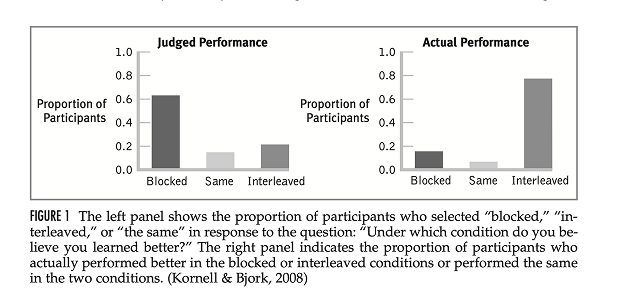 Figure 1: The left panel shows the proportion of participants who chose "blocked," "interleaved," or "the
same" as the answer to the question: "Under which condition do you think you learned best?" The right panel
shows the proportion of participants who actually performed better under blocked or interleaved practice, or
performed the same. (Kornell & Bjork, 2008)
Something fascinating here is that 63 % of the participants believed blocked practice worked best, but in reality almost 80 % performed better after interleaved practice. This shows that we are systematically poor at judging our own learning in the moment.
Bjork and Bjork distinguish between retrieval strength (how easily something comes to mind now) and storage strength (how well it actually sticks over time). The experiment shows that these two are not necessarily connected.
5. Deliberate practice, with a critical eye
Macnamara & Maitra (2019)In their original study of deliberate practice, Ericsson, Krampe & Tesch-Römer studied violin students in Berlin, and found that the number of hours of deliberate practice corresponded completely with skill level. This research is known for underpinning Malcolm Gladwell's "10 000 hour rule", which has long been a popular "recipe" for how to become good at something.
In Macnamara & Maitra's more recent study, this finding could not be recreated. They carried out a solid replication study in 2019, where they found an effect of practice, but considerably weaker than the original study. Teacher-led practice was not more decisive than practising alone, contrary to a common assumption. The effect size in the original study (0.70) was also strikingly high compared with a later meta-analysis across the music field (0.48).
This shows that not all widely cited "truths" about learning hold up equally well on closer inspection.
Preliminary summary
Across these five studies and principles I see a clear thread: active effort beats passive exposure. Whether it is retrieving information rather than reading it again, mixing topics rather than blocking them, or spreading the studying out rather than pressing it together, this is the move that brings both more friction and more learning. At the same time I have also understood that we are often poor at noticing this effect ourselves, because what feels most effective is rarely what actually sticks best.
The next step will be to see these principles in connection with interaction design literature.